Privacy Policy

We adhere to Google standard privacy policy that can be found here https://policies.google.com/technologies/partner-sites

Sunday, January 10, 2016

Northern California: Five Saprrows, a Bushtit and a Wren

[Bay Area, CA. Dec 2015]

Compared to the open, lush-green lands found in the Eastern US, the desolate brown landscape of Silicon Valley in California, with its water-deficient ecology, over development and high population density, seems wholly unsuited to harbor any birdlife other than Rock Doves, Starlings, Grackles and House Sparrows. Indeed, Save The Bay, lists several factoids with regard to the ongoing environmental degradation of San Francisco Bay:
  • Streams draining into the Bay have, on average, 3 pieces of trash per foot
  • Astonishingly, people dump 3 million gallons of oil annually into the Bay
  • While 1 in 4 Americans are infected with parasites from cat feces (generally without health complications), the same parasite can be lethal to Sea Otters [the 150 million dogs and cats in the US annually generate a tsunami of excrement that eventually finds is way into the sea resulting in unhealthy beaches frothing with E. Coli as well as parasite-rich waters that infect native wildlife]  
Yet, somewhat miraculously, a precious few oases of semi-wilderness can still be found in the Bay Area and a recent visit to this mecca of technology innovation afforded some time to explore hotspots such as Byxbee Park, Lucy Evans Baylands (both in Palo Alto) and WPCP (Water Pollution Control Plant in Sunnyvale) where the following species were observed:
  • Fox Sparrow
  • White-crowned Sparrow
  • Golden-crowned Sparrow
  • Song Sparrow
  • California Towhee
  • Bushtit
  • Bewick's Wren
We start with Fox Sparrow:


There are 4 species of Fox in the US. The red of the streaking on this somewhat large sparrow resembles the color of one of the four Fox species -- the Red Fox -- and, hence the name for this charismatic sparrow. 

However, note that the resemblance to the Red Fox is "most true" for the Red race of the Fox Sparrow. The race shown here is the Slate-colored Fox Sparrow and an even darker variant, the Sooty Fox Sparrow, is found in the coastal Northwest. This outstanding individual was seen at Byxbee Park.

White-crowned Sparrow is a common songbird in this area and practically every birding venue has them in relative abundance:


In addition to White-crowned Sparrow, a few Golden-crowned Sparrows were seen at Lucy Evans Baylands in Palo Alto:


Over at WPCP, this blogger was surprised to hear Song Sparrows singing -- in December!


Our final sparrow is the near-endemic California Towhee (found outside the US only in Mexico):

California Towhee seen at Byxbee Park

Unlike the robust Towhee, the Bushtit is a hyperactive, tiny bird that blends in with the shrubs:


In the vicinity of where the Bushtit were sighted (Charleston Slough), a Bewick's Wren also made a brief appearance:


This western wren looks like a House Wren with a long tail and is now exceedingly uncommon in the East where it is being displaced by the House Wren.

Arnold Schwarzenegger is not only known for his muscle-bound roles in movies, but also as the Governor of California who signed into law, legislation that made it mandatory for kitty litter brands to carry a warning not to dump kitty feces into toilets or storm drains. This was necessitated by the unprecedented deaths of Sea Otters on California coasts and is a grim reminder of the ripple effects of how non-native animals in urban settings can still have devastating consequences on wildlife hundreds of miles away.

Saturday, January 2, 2016

Estero Llano: Clay-colored Thrush, Green Jay and Long-billed Thrasher

[Weslaco, TX. Dec 2015]

In the prior post, we noted how Texas dominates diversity in avifauna in the country not only because of its massive size but also because of its proximity to Mexico. And, proximity to Mexico inevitably implies a bonanza of tropical species. 

But unlike our other neotropic species such as warblers and tanagers that are found across the country; these tropical species barely reach into US territory and remain localized in our border regions with Mexico. The RGV (Rio Grande Valley) region includes fabled hotspots such as Estero Llano Grande State Park in Weslaco, TX, where a quick visit gave up some iconic tropical species such as:
  • Clay-colored Thrush
  • Long-billed Thrasher
  • Curve-billed Thrasher
  • Green Jay
  • Great Kiskadee; and,
  • Plain Chachalaca
We start with a very special thrush -- one that is the state bird of Costa Rica and is found in the US only in Southern Texas; the Clay-colored Thrush (fka Clay-colored Robin):


This beautiful thrush with its delicate hues of brown and cinnamon is about the same size as an American Robin. Note the white throat with fine streaking; the yellow bill and dark red eyes.

Next, the tropical version of Brown Thrasher -- Long-billed Thrasher:


Compare with Brown Thrasher:


In addition to the obvious difference in bill length, note the grey face of the Long-billed (vs. brown) and dark streaking vs. rufous streaking on the Brown Thrasher.

Another thrasher -- the much more widely ranging Curve-billed Thrasher:


The next bird, Green Jay, could be the poster child for a tropical species:


Flamboyantly colorful with green, blue, black and yellow, the Green Jay is our most colorful corvid.

Next, an imposing flycatcher:


Great Kiskadee is a flycatcher on steroids -- large, colorful and loud.

Plain Chachalaca is the only member of the Cracidae family in the US comprising Chachalacas, Guans and Curassows.


These are loud and gregarious birds and, despite their size, remain mostly hidden in the shadows.

The tropics hold a special fascination for American birders and an easy way to visit the tropics without leaving the US is to partake of the avian delights found in the RGV region.

Sunday, December 27, 2015

Polyavian delights at Polywog Ponds: Green Kingfisher and Western Tanager

[Corpus Christi, TX. Dec 2015]

It is said that "Wealth lies in the eye of the beholder" (in taking liberty with a well known adage). Indeed, one could rank our 50 states by wealth in population; or income, or by days of sunshine; or by whatever metric suits one's definition of "wealth". Surely this is a subjective exercise but in relation to our avifauna, the states endowed with the most birding riches are Texas, California and Arizona. Texas, especially, is unique in affording observation of both Western and Eastern species in an unparalleled variety of habitats ranging from tropical, woodland, montane, desert, prairie and coastal. The lonestar state is exceptionally well blessed with a plethora of specialty and highly coveted species that are best seen here than anywhere else in the US.

A family vacation in Texas provided a couple of opportunities that underscored exactly why Texas is the heavyweight in the world of birding. One remarkable hotspot explored during this trip is Polywog (also spelt Pollywog) Ponds in Corpus Christi which yielded a delightful assortment of species such as:

The incomparable Green Kingfisher:


It is a lamentable fact that most birders in this country are acquainted solely with a single Kingfisher species -- the Belted Kingfisher. The Green Kingfisher is everything that the Belted is not -- it is tiny (about the size of a sparrow); the male has a prominent rufous chest band (in the Belted, it is the female that sports this feature); and its plumage is wholly devoid of blue. 


Of course, there are similarities too between the Green Kingfisher and the Belted -- both are highly skittish; their vocalizations consist of rattling calls and clicks and their feeding and breeding habits are almost identical.  


The trademark looks of the kingfisher -- manifesting a heron's bill on a songbird's body atop the tiny legs of a swallow -- are consistent throughout the members of this global family. And, if the Green Kingfisher is on your lifelist, there's a very good chance that the observation was made in Texas (where their range is much larger than in SE AZ).

At the entrance to Polywog Ponds, a medium-sized yellowish bird with two prominent wingbars was observed -- a Western Tanager:


Southern Texas is not normally in this songbird's range, so this sighting was wholly unexpected.


Western Tanagers are found from British Columbia to New Mexico and are considered to be the Western equivalent of the Scarlet Tanager.

Other species observed were -- Couch's Kingbird:


This kingbird is another Texan specialty and its closest relative is Tropical Kingbird. They are visually indistinguishable save for the thicker bill of the Tropical. However, their vocalizations are distinct and, where their ranges overlap, they do not interbreed.

White-winged Dove:


and a glorious Roseate Spoonbill flyby:


In the end, it is not our possessions that will define us. The experiences we receive and those we bequeath to others will be the true testament to wealth in our lifetime. And, in Texas, a wealth of exceptional birding experiences await the intrepid birder.
==========================
Photo of entrance:


Link to geotagged photo for map location.

Thursday, December 10, 2015

Tanque Verde Wash & Sweetwater Wetlands: Cassin's Vireo, Phainopepla, Ladder-backed Woodpecker

[SE AZ. April and August 2015]

For all our ecologically righteous "gnashing of teeth" over the lamentable loss of habitat and the the squeezing out of wildlife by the inexorable (and hideous) march of "development", it will be no small relief to know that a surprising assortment of species are able to eke out an existence in a couple of small oases of nature found in the urban sprawl of Tucson: hotspots such as Tanque Verde Wash and Sweetwater Wetlands. And, a trip to Tucson earlier this year at these fabled venues was aptly rewarded with glorious sightings of:
  • Cassin's Vireo
  • Phainopepla
  • Yellow Warbler
  • Ladder-backed Woodpecker
  • Greater Roadrunner
  • Western Tanager
  • Common Yellowthroat
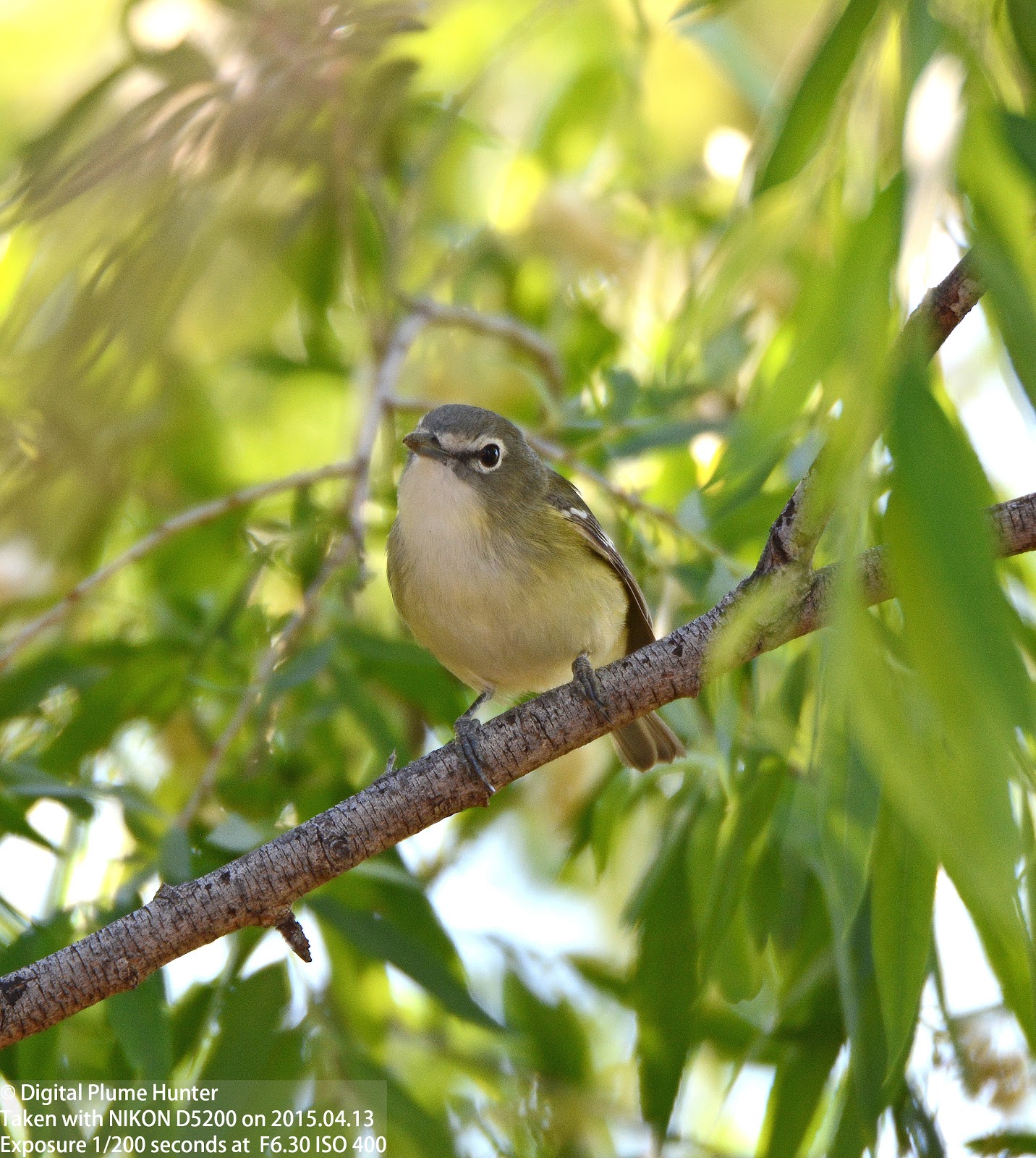
First, Cassin's Vireo:


Cassin's Vireo is a gift to the birding community through the wonderfully beneficent act of "splitting" by the AOU in 1997. Cassin's erstwhile incarnation was that of the "Solitary Vireo" -- which has been replaced by our 3 spectacled vireos: Cassin's Vireo, Blue-headed Vireo and Plumbeous Vireo. At Tanque Verde Wash, Cassin's Vireo was observed vocalizing frequently in the trees. Disambiguation with the Plumbeous is simple thanks to the overall grey color scheme of the latter. However, confusion of Cassin's and Blue-headed is inevitable -- and although there are subtle differences, the easier method is to rely on their (largely) distinct ranges (see the Blue-headed Vireo here).
 
Next, Phainopepla:


Both a female and a male were observed. This is the only member of its family present in the US. While it is only found in the desert Southwest, the next species should be familiar to all:

Yellow Warbler:


The Ladder-backed Woodpecker may look familiar -- it closely resembles Nutall's Woodpecker and sometimes it is even confused with Red-bellied Woodpecker; but there is no mistaking the red-crown and prominent eye-stripe:


While Tanque Verde Wash is excellent for songbirds, Sweetwater Wetlands (on the other side of town), offers a different mix of species -- especially waterfowl in winter. However, on this visit, a curious spectacle was observed -- a Roadrunner tailing a rather large snake:


Up in the trees, a Western Tanager was a nice surprise:


Finally, any habitat with marshy conditions is perfect for Common Yellowthroat:


Amidst the concrete jungle of Tucson, two outstanding hotspots offer the intrepid birder a chance to savor some choice species that are both familiar as well as extraordinary.